


In 2025, this consultation explored the strengths and areas for improvement in the implementation of the Programme and its strategy for amplifying results.
Let’s discover what you think and how do yo perceive us!
1. A Diversity of Projects Highlighted and Appreciated
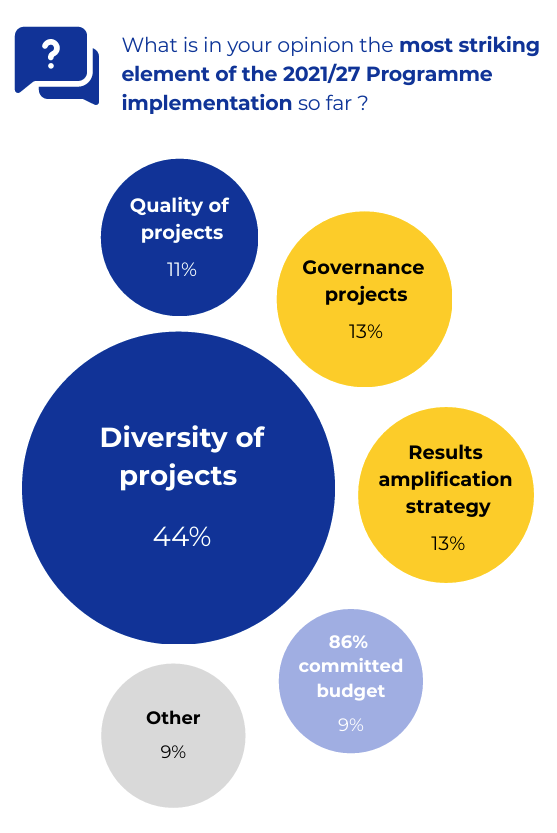
Receiving 55% of responses, the diversity and quality of funded projects is seen as the Programme’s primary strength.
Indeed, the various types of thematic projects offered—study, test, transfer, and strategic territorial projects—are a differentiating asset and proof of the Programme’s innovation. It is to be noted that the survey was conducted in November 2025 (see detailed methodology at the bottom of this page), with already 96 projects underway. Most of them will end their activities between 2026 and 2028.
In open-ended responses, participants highlighted:
- The Programme’s ability to continuously integrate new actors into transnational cooperation.
- Its capacity to drive a forward-looking strategy for the Mediterranean.
Interreg Euro-MED’s key quality is its capacity to transform scattered initiatives into a shared strategic pathway around key priorities for the whole Mediterranean (…) Overall strategy and coordination between different projects as well as a variety of projects able to deal with the different challenges to be addressed.
The possibility of allowing targeted funding to implement innovative sustainability policies, particularly for smaller local/public authorities that usually do not have the capacity and/or know-how to access funding via more complex mechanisms or mainstream funds.
Respondents also praised the Programme’s success in committing 86% of its 2021-27 budget, while expressing a desire for further simplification of procedures. This will be a major challenge in transitioning to a performance-based approach for the 2028-2034 period.
Speed and proactivity because you are the first in all the steps of the programming cycles (…) The professionalism of the Joint Secretariat always available to support projects and committed to making the best of the Programme.
The administrative complexity and heavy reporting requirements, which can discourage smaller actors and slow down implementation (…) Having greater flexibility for the implementation of activities and budget.
2. A Recognised Capitalisation Dynamic to Be Strengthened
For nearly a quarter of respondents, capitalisation of results is the Programme’s main strength, particularly the implementation of a strategy to optimise results (13%) and the establishment of governance projects to oversee each of the four missions (13%).
The regular cooperation among the Governance projects and with the Joint Secretariat fosters the sense of (co-)ownership, contributes to the co-design of cross-cutting actions, and is the key to success in building a comprehensive strategy for a more sustainable region.
I would mention the capitalisation strategy, building on the results of previous projects without reinventing the wheel!
While these 2021-2027 innovations are recognised and praised, there is still room for improvement in the next programming period. Several respondents suggested ways to simplify the functioning of missions and governance projects.
A solution could be, for the next programming period, to have only one project working under one mission, with a larger partnership that works in two sub-groups on the two layers (community and institutional) (…) A single governance consortium per mission—albeit with more partners and allocated funding—would work best.
Clearer guidelines on how thematic projects should interact with the Interreg Euro-MED Programme and Communities: synergies with other projects, contribution to Euro-MED Academy, etc.
3. Better Communicating Project Results to Public Authorities and the Private Sector
Respondents are clear: capitalisation must primarily target decision-makers.
Only 51% of respondents believe that project results are well or very well known to decision-makers. In contrast, 31% think they are only partially known, and 18% believe they are poorly or very poorly known.
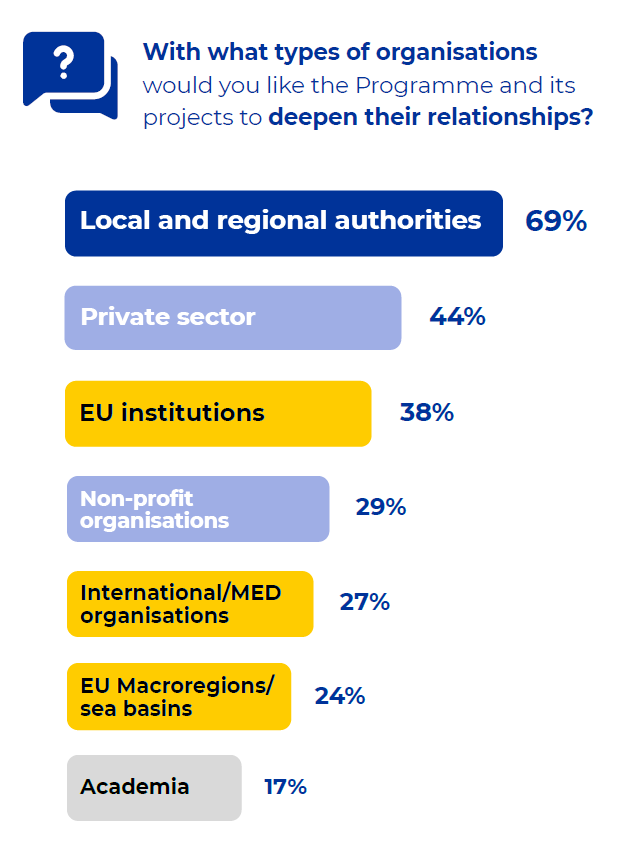
Which decision-makers should be prioritised? Local and regional authorities are cited first (69%), followed by the private sector (44%). The latter outpaces European institutions (38%), and macro-regional or basin strategies (24%).
Respondents stress the need to increase private sector involvement in implementing results and driving change, which includes non-profit private sector as NGOs are cited by 29% of the respondents.
Many of the solutions developed are of great value, but they often struggle to reach policy-makers, local administrations, and private operators who could apply them in practice.
The programme would need to finance demonstrators and pilot sites to improve its visibility and impact on decision-makers, as well as involving the private sector to target territorial issues.
4. Amplifying Results for Decision-Makers: Impact, Integration, Lobbying
To convince decision-makers, respondents emphasise the need to demonstrate the concrete local impact of projects, align with national strategies, and strengthen the dissemination and promotion of results—both by the projects and the Programme.
In other words, achieving a leverage effect through concrete, replicable, and scalable success stories.
Including and funding effective dissemination plans at the regional and local level as a part of the project commitments (…) Disseminate the territorial impact of the results, tangible results of the investments.
Lobbying (…) Permanent presence in European lobbies (…) Include NGOs and CSOs as partners (…) Target clear decision-makers in each mission and approach them through the governance projects, lobby actions (…) It needs to improve by ensuring better integration with national strategies.
5. The Mediterranean Multiprogramme Mechanism: An Opportunity for Visibility and Influence
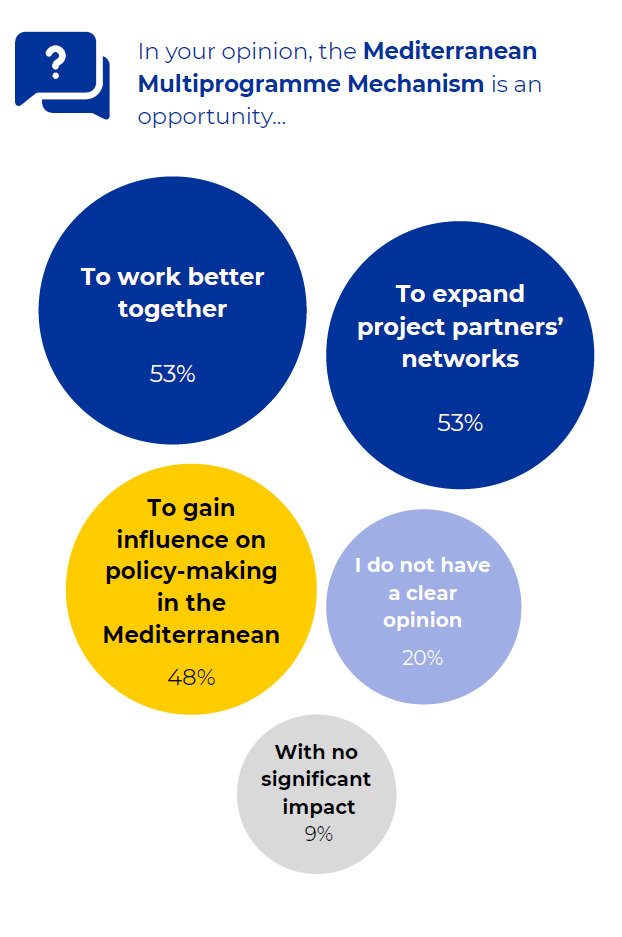
For 53% of respondents, the MMM represents an opportunity for its member Programmes to work better together and expand their partner networks. 48% also see it as a way to increase their influence on public policies in the Mediterranean area.
As a recent initiative, the MMM still needs to establish itself: only 40% of respondents reported receiving updates about the Mechanism over the past year.
The 2026 launch of two flagship actions—a coordinated call for projects and the implementation of inter-project and inter-Programme visits—will provide opportunities for dissemination and capitalisation. This last point is widely emphasised by respondents.
The success of the MMM coordinated call will depend on ensuring real regional uptake of the solutions developed and securing strong private-sector involvement from the start, so that projects are both policy-aligned and market-ready.
A real commitment to transferring and scaling up the most effective solutions (…) Targeting the real and scalable pilot cases for real-life tourism challenges. Clear set of guidelines on how these projects should develop synergies and cross-fertilise with other EU Programmes and initiatives.
Methodology of the Survey
The 2025 consultation questionnaire was sent to Interreg Euro-MED Programme stakeholders from 15 November to 15 January 2025. It included 9 closed-ended questions (single or multiple-choice) and 8 open-ended questions for free expression.
A total of 45 respondents, primarily from the 14 countries in the Programme’s cooperation area, completed the survey. While the statistical significance of the responses remains limited due to a high margin of error (±14%), these results provide the Joint Secretariat with valuable insights to be cross-referenced with other sources (formal and informal exchanges, project outcomes, strategies, etc.).
The information in this article corroborates reflections and feedback gathered from other discussions and contexts.
